
AFTER THE HOUR OF LIBERATION adapts its title from Heiny Srour’s 1974 film, The Hour of Liberation has Arrived, which captured the Marxist-Leninist rebellion against the British in the Dhofar region of Oman as it unfolded. In contrast, the films in this program document the afterlives of revolution; each revisits a resistance movement and centers the women—some infamous, others overlooked—who were at the forefront of these anticolonial struggles. Filmed decades later, freedom fighters from Algeria, Palestine, and Vietnam reflect on their role alongside their male counterparts, as well as their current circumstances and the temporality of liberation. In more recent video works by Marwa Arsanios and Huda Takriti, the artists examine the representations and imaginations of Djamila Bouhired and Leila Khaled respectively, unpacking the simultaneous celebration and marginalization of these women as they are transformed into icons.
AFTER THE HOUR OF LIBERATION is curated by Dina A. Ramadan and is co-presented by ArteEast and DCTV. This program is part of the legacy program Unpacking the ArteArchive, which preserves and presents 20 years of film and video programming by ArteEast. Selections from AFTER THE HOUR OF LIBERATION will be screened in-person at DCTV on February 10th followed by a discussion with Samah Selim moderated by the curator. For more information about the in-person screening visit firehousecinema.dctvny.org. The full program will be screened online on artearchive.org from February 11 - 21 2026.
Ghostly halls of a waterlogged archive represent the infinite perspectives and information that have been lost. What we conserve of our history as collective memory is accident as well as the careful collection of specific narratives that create views of history. This work is about the millions of lost images that exist only in the minds of citizens and those who try to reconstruct history from the remaining evidence. The video moves through a particular case of absence to investigate the meaning of images for the creation of truth.
In August 1969, Leila Khaled and Salim Al-Issawi, members of the Popular Front for the Liberation of Palestine (PFLP), hijack flight TWA840 on its way from Rome to Tel-Aviv, diverting it to Damascus. Leila describes details of the operation and the PFLP’s intentions behind blowing up the empty plane in Damascus in her autobiography, stating that a photographer hired by the PFLP was waiting at the airport to document the explosion for archival purposes. Nevertheless, he forgets to take off the cap of his camera lens, and the archive is left with a black photograph.
The artist takes the black photograph as a point of departure, investigating what images can tell us and how we read them in relation to historiography. Making connections between existing images and computer-generated imagery, the work proposes to the viewer a kaleidoscopic narrative where images occupy many positions: archival, historical, familiar, strange, and fictional. A narrative where the past, present, and future overlap temporally and spatially.
About the Filmmaker
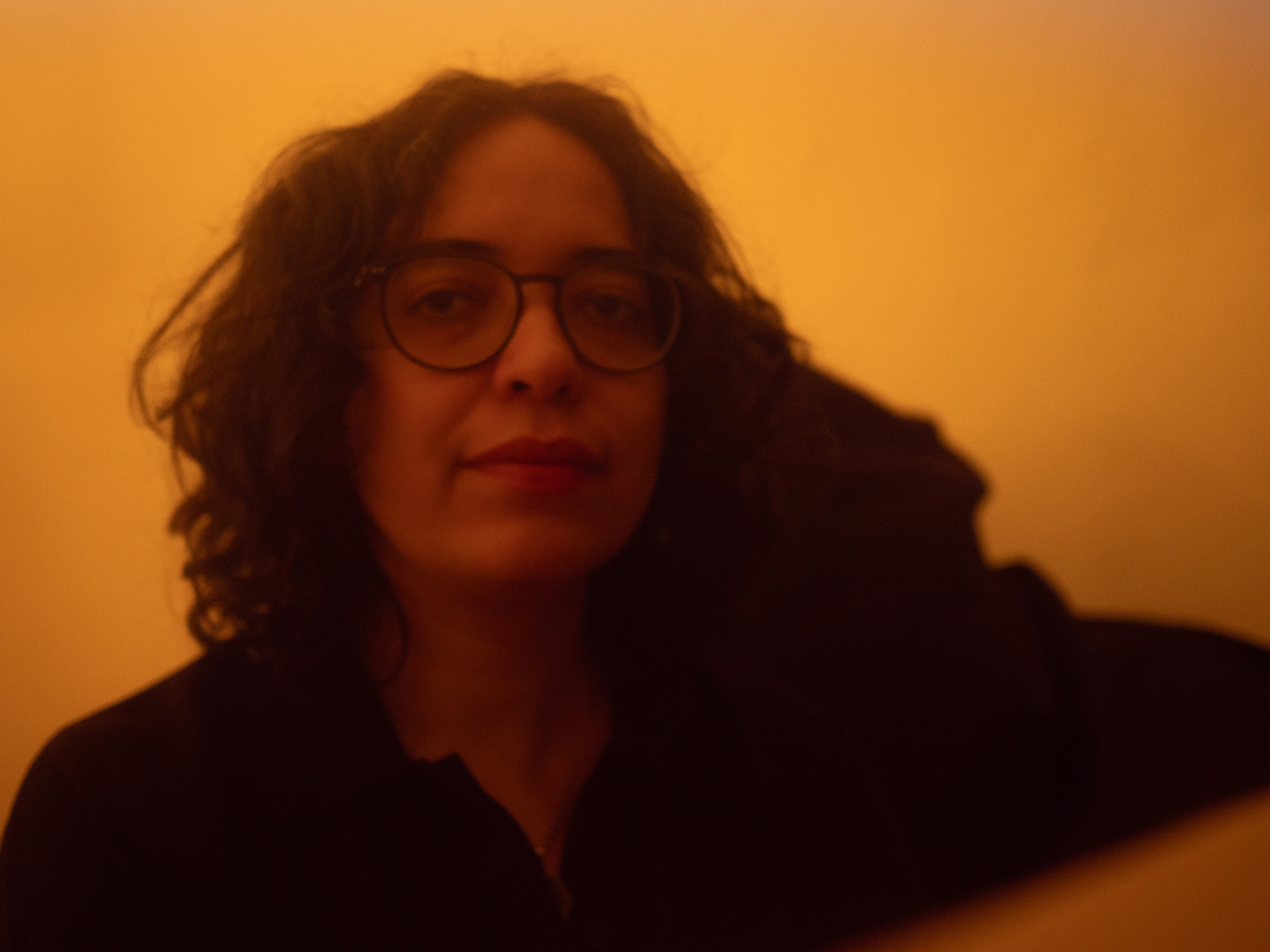 Huda Takriti (b. 1990 in Syria) uses video and installation to question hidden histories within colonial and state archives. Her work analyzes how systems of power define memory through a decolonial and feminist lens. She is currently pursuing a PhD in practice at the Academy of Fine Arts in Vienna, where she is examining the notion of archival erasure relating to the (hi)stories of female freedom fighters from the Middle East in times of armed anti-colonial struggle. Questioning the construction and production of historical narratives, as well as the potential that contamination can carry as a way for surviving archival gaps. Huda Takriti's latest exhibitions include MQ Freiraum (AT), Kunsthalle Wien (AT), mumok (AT), Kunstraum Lakeside (AT) and Škuc Gallery (SL). Takriti received the Han Nefkens Foundation - Museu Tàpies Video Art Production Grant (2025), the Vordemberge-Gildewart Scholarship (2022), the Kunsthalle Wien Prize (2020), and the Camargo Foundation Fellowship (2023).
- Year2022
- Runtime14 mins.
- LanguageEnglish
- CountrySyria
- DirectorHuda Takriti
- ProducerHuda Takriti and Ettijahat- Independent Culture, Laboratory of Arts, 7th Edition
- AnimatorBeniamin Urbanek and Franz Schubert
- Sound DesignBeniamin Urbanek and Huda Takriti
AFTER THE HOUR OF LIBERATION adapts its title from Heiny Srour’s 1974 film, The Hour of Liberation has Arrived, which captured the Marxist-Leninist rebellion against the British in the Dhofar region of Oman as it unfolded. In contrast, the films in this program document the afterlives of revolution; each revisits a resistance movement and centers the women—some infamous, others overlooked—who were at the forefront of these anticolonial struggles. Filmed decades later, freedom fighters from Algeria, Palestine, and Vietnam reflect on their role alongside their male counterparts, as well as their current circumstances and the temporality of liberation. In more recent video works by Marwa Arsanios and Huda Takriti, the artists examine the representations and imaginations of Djamila Bouhired and Leila Khaled respectively, unpacking the simultaneous celebration and marginalization of these women as they are transformed into icons.
AFTER THE HOUR OF LIBERATION is curated by Dina A. Ramadan and is co-presented by ArteEast and DCTV. This program is part of the legacy program Unpacking the ArteArchive, which preserves and presents 20 years of film and video programming by ArteEast. Selections from AFTER THE HOUR OF LIBERATION will be screened in-person at DCTV on February 10th followed by a discussion with Samah Selim moderated by the curator. For more information about the in-person screening visit firehousecinema.dctvny.org. The full program will be screened online on artearchive.org from February 11 - 21 2026.
Ghostly halls of a waterlogged archive represent the infinite perspectives and information that have been lost. What we conserve of our history as collective memory is accident as well as the careful collection of specific narratives that create views of history. This work is about the millions of lost images that exist only in the minds of citizens and those who try to reconstruct history from the remaining evidence. The video moves through a particular case of absence to investigate the meaning of images for the creation of truth.
In August 1969, Leila Khaled and Salim Al-Issawi, members of the Popular Front for the Liberation of Palestine (PFLP), hijack flight TWA840 on its way from Rome to Tel-Aviv, diverting it to Damascus. Leila describes details of the operation and the PFLP’s intentions behind blowing up the empty plane in Damascus in her autobiography, stating that a photographer hired by the PFLP was waiting at the airport to document the explosion for archival purposes. Nevertheless, he forgets to take off the cap of his camera lens, and the archive is left with a black photograph.
The artist takes the black photograph as a point of departure, investigating what images can tell us and how we read them in relation to historiography. Making connections between existing images and computer-generated imagery, the work proposes to the viewer a kaleidoscopic narrative where images occupy many positions: archival, historical, familiar, strange, and fictional. A narrative where the past, present, and future overlap temporally and spatially.
About the Filmmaker
Huda Takriti (b. 1990 in Syria) uses video and installation to question hidden histories within colonial and state archives. Her work analyzes how systems of power define memory through a decolonial and feminist lens. She is currently pursuing a PhD in practice at the Academy of Fine Arts in Vienna, where she is examining the notion of archival erasure relating to the (hi)stories of female freedom fighters from the Middle East in times of armed anti-colonial struggle. Questioning the construction and production of historical narratives, as well as the potential that contamination can carry as a way for surviving archival gaps. Huda Takriti's latest exhibitions include MQ Freiraum (AT), Kunsthalle Wien (AT), mumok (AT), Kunstraum Lakeside (AT) and Škuc Gallery (SL). Takriti received the Han Nefkens Foundation - Museu Tàpies Video Art Production Grant (2025), the Vordemberge-Gildewart Scholarship (2022), the Kunsthalle Wien Prize (2020), and the Camargo Foundation Fellowship (2023).
- Year2022
- Runtime14 mins.
- LanguageEnglish
- CountrySyria
- DirectorHuda Takriti
- ProducerHuda Takriti and Ettijahat- Independent Culture, Laboratory of Arts, 7th Edition
- AnimatorBeniamin Urbanek and Franz Schubert
- Sound DesignBeniamin Urbanek and Huda Takriti